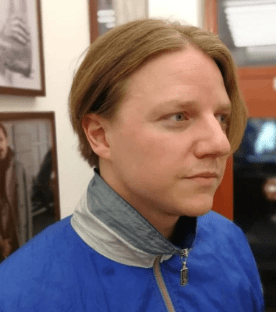
Victor Johansson is a PhD student in education at Stockholm University. He has experience working for several different youth associations. Hence, an interest in what is often called the “civil society” has followed him throughout his university studies in history, education and sociology. He wrote a masters thesis on the topic of late modern transformations of volunteering in Sweden. His current research also concerns the associational life of youth, but in the context of schooling, and his supervisors are Daniel Lövheim, Joakim Landahl and Rebecca Yee. He is currently in his fourth year as a PhD student.
Interviewer: What is your research topic?
Victor: I’m interested in how the diffusion of a democratic political culture to the realm of schools in the twentieth century Sweden has had the effect of pupils organizing into political actors. I study the history of secondary school students (pupil’s) organized participation in Swedish educational politics throughout the era of the democratic welfare state (1938-2005). One aspect of this participation is of particular interest, namely that pupils formed national special interest associations. The empirical focus of the dissertation is thus the formation, developments, and political activities of those organizations as well as their contextual conditions.
Interviewer: What made you follow this particular academic path?
Victor: My engagement in, and with, youth associations is lifelong. As an academic interest it could only be compared to my fascination for education. The opportunity to study youth associations within the frame of educational politics was thus a perfect match for me. I am grateful to the PEDASK research school for providing this opportunity, as well as for my department/supervisors for believing in the idea.
Interviewer: Have you made any changes in your research topic? How are your progressing, are you satisfied?
Victor: To be honest, I have known from the start that I wanted to study the case of pupil associations, but I had to figure out what I was actually studying – what they were a case of? Relating the investigation to the study of political participation is a fairly new development. I’m quite satisfied with how the work is progressing so far. However, since I’m writing a monograph (i. e. not publishing articles) it is hard to assess the quality of the writing. But I do get help with that from external readers and especially my supervisors, with whom I am very pleased.
Interviewer: Apart from your research do you have other academic tasks?
Victor: I have been teaching quite extensively throughout the years on the department’s courses in history of education on the teacher training program. Me and my college Anna have been course leaders for an online course in the history and sociology of education, which has been great fun! I have also been vice chair and board member of the department doctoral student council for two years, although now after this summer I’m “stepping down”.
Interview by Angjela Preci, MA student, University of Groningen
 appliedhistoryofeducation.school.blog